
Introduction
Every founder dreams of a sales engine that hums predictably whether they are in the room or a thousand miles away. Yet for most growing businesses, revenue is intimately tied to the founder’s personal network, pitching skills, and relationship magic. The founder is the top salesperson, the ultimate closer, and the only one who truly understands the nuances of the value proposition. This works brilliantly until the day the founder wants to step back, launch a second product, or simply take an uninterrupted vacation.
The problem is not the founder’s talent. The problem is that talent has never been translated into a system. Revenue does not have to stop when you do, but that requires something far more intentional than hiring a few salespeople and hoping they figure it out. It requires designing a revenue architecture: a deliberately engineered system of processes, people, tools, and metrics that reliably generates revenue without depending on any single individual, including you.
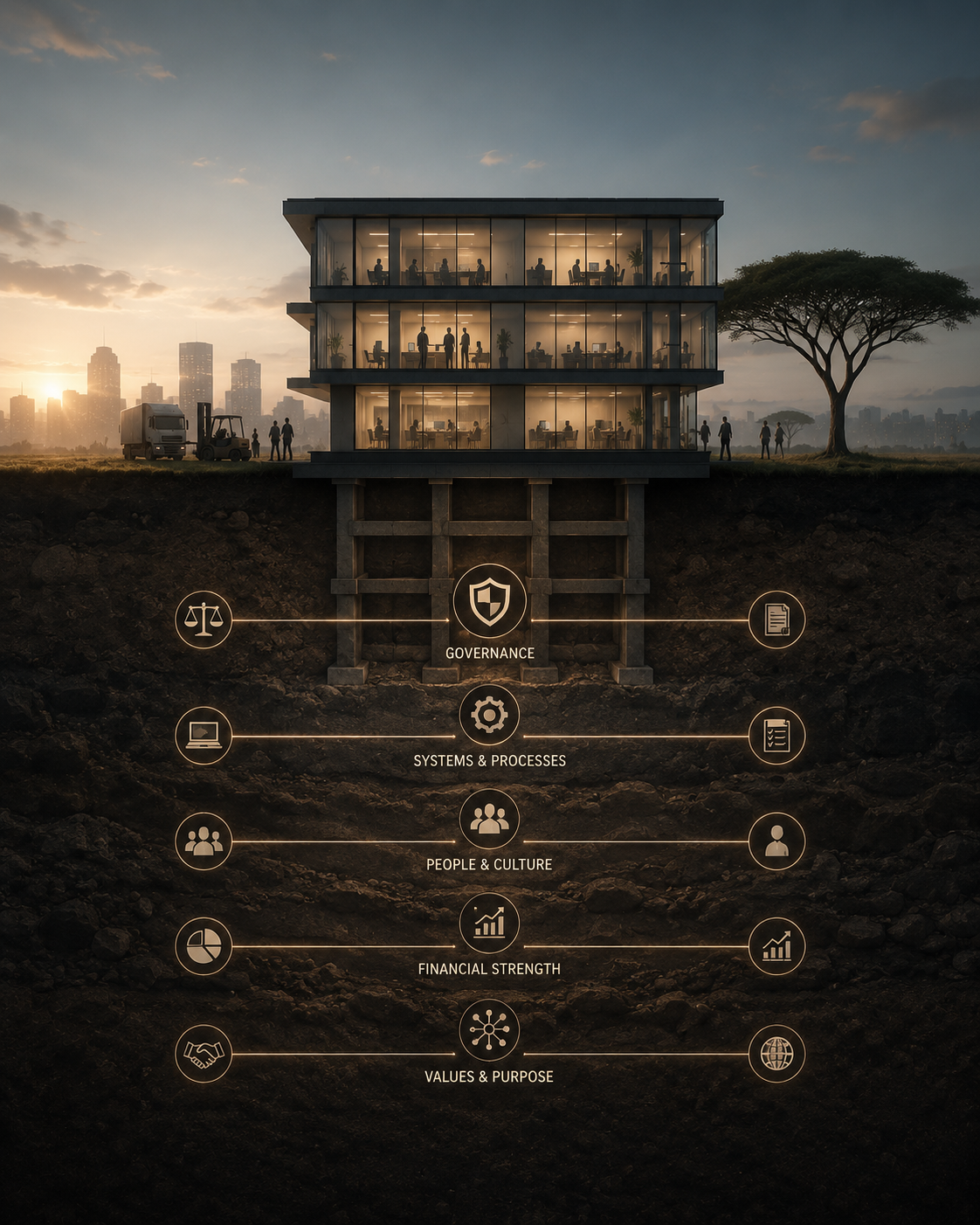
Revenue architecture is not a piece of software. It is not a sales script. It is the structural design of how your company attracts, engages, wins, and grows customers. When done right, it functions like a well-designed building: load-bearing walls distribute weight so that no single column carries everything. The founder becomes the architect who designed the structure, not the one holding up the roof.
This guide will walk you through the complete blueprint, from defining your unique revenue code to installing the coaching loops that keep the engine improving on its own. By the end, you will have a framework for building a sales system that can run, learn, and scale without your daily heroic effort.
What Revenue Architecture Actually Means
Revenue architecture is the deliberate, holistic design of a company’s revenue-generating system. It encompasses every element that turns a market opportunity into cash in the bank, arranged in a way that is repeatable, measurable, and scalable. Unlike a simple “sales process,” which often focuses narrowly on the steps a rep takes from lead to close, revenue architecture considers the entire ecosystem in which those steps occur.
A complete revenue architecture includes:
- The customer journey stages, precisely defined with entry and exit criteria.
- The roles and responsibilities across marketing, sales, and customer success, eliminating handoff friction.
- The technology stack that captures data and enforces process without adding administrative drag.
- The set of metrics that diagnose system health, not just individual performance.
- The meeting rhythms and coaching cadences that turn insights into continuous improvement.
When a founder says “I need to get out of sales,” they often mean they need a revenue architecture. They are not asking for permission to neglect revenue. They are asking for a structure that makes their personal involvement a strategic choice rather than an operational necessity.
Step One: Extract Your Founder Sales Code
The first component of your architecture is the hidden “sales code” currently locked in your head. This is the combination of questions you ask, the way you frame value, the objections you anticipate, the stories you tell, and the decision-making shortcuts you apply when qualifying or closing. Your team cannot replicate your results because they have never seen this code made explicit.
To extract it, you must reverse-engineer your own sales conversations. Record yourself on a handful of real calls or prospect meetings, then analyze the patterns. Look specifically for:
- The exact language you use to shift a prospect from curiosity to urgency.
- The three to five qualifying questions you ask intuitively that your reps never think to ask.
- The way you structure a proposal narrative so that price becomes a logical conclusion rather than a surprise.
- The objections you treat as “not a fit” versus those you lean into and reframe.
Once you have identified these patterns, document them. Not as a rigid script, but as a playbook of frameworks, principles, and example language. This playbook becomes the intellectual property of the business, not just your personal bag of tricks. It is the first load-bearing beam in your architecture. When a new rep joins, they don’t start from scratch; they start from your best thinking, codified and teachable.
Step Two: Design the Customer Journey Architecture
With your sales code externalized, you now need a process architecture that guides every opportunity from first contact to closed deal and beyond. This is not about imposing a sales methodology for its own sake; it is about creating a shared operating system that everyone uses to communicate about revenue.
Define your customer journey as a series of clear, observable stages. Common stages in a B2B context include:
- Suspect: A name or company that fits your ideal customer profile but has not engaged.
- Lead: A contact who has shown some intent (website visit, content download, event attendance).
- Qualified Opportunity: A contact who has explicitly acknowledged a relevant problem, a timeline, and willingness to explore solutions.
- Solution Shaping: The stage where you co-create a vision of the solution with the prospect, including demos, proposals, and stakeholder alignment.
- Negotiation and Commitment: Final terms discussion, procurement, and signed agreement.
- Onboarding and Live: The handoff to delivery and the initial value realization period.
- Expansion Ready: An existing customer with clear signals for upsell or cross-sell.
For each stage, define entry and exit criteria so precise that two different managers would make the same judgment about a deal’s status. For instance, “Qualified Opportunity” exit criteria might be: “Prospect has stated a business problem in their own words, confirmed a target decision date within 90 days, and introduced us to at least one other stakeholder.”
This stage architecture becomes the backbone of your CRM configuration, your forecast calls, and your coaching conversations. It allows you to see the entire revenue factory from a single view, without needing to ask “what’s happening with this deal?”
Step Three: Install the Right Metrics Array
A revenue architecture is only as good as the signals it sends back to leadership. Too many companies track activity metrics that sound busy but reveal nothing about system health: calls made, emails sent, meetings held. Those are input metrics. A founder-independent sales system is governed by outcome and conversion metrics that tell you whether the architecture itself is performing.
The essential metric categories are:
- Volume metrics: The number of new leads, qualified opportunities, and closed deals per period. These tell you if the top of the engine is healthy.
- Conversion metrics: The rate at which deals move from one stage to the next. A dip at a specific stage pinpoints the structural bottleneck.
- Velocity metrics: The average time a deal spends in each stage and the total cycle time. Slowing velocity often signals unclear exit criteria or weak qualification.
- Value metrics: Average deal size, customer acquisition cost, and lifetime value. These ensure you are not just accelerating revenue but profitable revenue.
- Health metrics: Forecast accuracy, win rate by source and rep, and pipeline coverage ratio. These give leadership confidence to make investment decisions without the founder’s gut feel.
Present these metrics in a simple dashboard that leadership reviews weekly. The goal is not to micromanage reps but to manage the system. When the metrics are stable and within target ranges, the founder can trust the architecture and step back. When a metric moves out of range, it points precisely to the component of the architecture that needs attention, a coaching intervention, a process tweak, or a resource adjustment.
Step Four: Distribute Sales Capability, Not Just Targets
A common mistake is to hire salespeople, hand them targets, and assume the architecture will run itself. But revenue architecture is not just a process diagram; it is a capability distribution system. It must ensure that every rep has the skills, judgment, and resources to execute the founder’s sales code without constant direct coaching from the founder.
This requires three things.
First, build a sales playbook that goes far beyond product features. It should contain:
- The ideal customer profile and the questions that quickly disqualify poor fits.
- Battle cards for top competitors, with positioning angles and objection responses.
- Email and call frameworks for each customer journey stage, with examples of “what good sounds like.”
- Pricing and negotiation guidelines, including the boundaries within which a rep can make decisions without escalation.
Second, create a structured onboarding path that certifies reps on the architecture. Certification means they have demonstrated competency in a simulated or real low-stakes opportunity across every stage, and a manager has signed off. This is not a one-week product training; it is a deliberate apprenticeship in your revenue code.
Third, implement a peer-coaching element. Encourage senior reps to lead deal clinics where the team collectively dissects a stuck deal using the architecture’s lens. This socializes problem-solving and deepens the team’s collective ownership of the system. When reps start coaching each other using the common language of stages, criteria, and metrics, you know the architecture is no longer dependent on the founder.
Step Five: Construct the Technology Spine
Technology is the skeleton of your revenue architecture. It provides the rigidity and repeatability that human memory and spreadsheets cannot. Without it, your beautifully designed stages and criteria remain theoretical.
The core spine consists of three integrated systems:
- CRM: The single source of truth for all opportunity and contact data. It must be configured to mirror your customer journey stages, with mandatory fields at stage transitions to enforce data integrity. If a rep cannot move a deal forward without entering the key information, data decays less.
- Marketing automation or engagement platform: This feeds the CRM with lead source data and behavioural signals, enabling reps to have contextual conversations and allowing the system to track which channels generate the best opportunities.
- Revenue intelligence or conversation analytics: Modern tools that capture and analyze sales calls and emails can surface which parts of the sales code are actually being used in the field, and which are drifting. This closes the loop between the documented playbook and real-world execution.
The technology spine is not about monitoring every minute of a rep’s day. It is about making the architecture visible and enforceable without the founder constantly auditing. When a manager opens the CRM, they should see a clean pipeline that reflects reality, with flags automatically raised for deals that have been stagnant too long or that skip stages. The system manages the process; humans manage the exceptions.
Step Six: Install the Meeting and Coaching Cadence
The architecture, once built, must be maintained through a predictable drumbeat of meetings and coaching. These rituals are the operating system that keeps the revenue engine running without the founder’s physical presence.
The essential rhythms are:
- Weekly pipeline review: Each manager meets with each rep for a focused session on deal health, next actions, and stuck deals, using only CRM data. The founder attends only as an observer, if at all, eventually stepping away entirely.
- Biweekly team deal clinic: A collaborative session where the team brings anonymized or real deals that are stuck and works through them using the architecture’s frameworks. This builds shared capability.
- Monthly revenue system review: Leadership reviews the key metrics (conversion, velocity, win rates) and identifies one or two systemic improvements to the architecture itself. This is where the sales code gets updated, where stage criteria are refined, and where competitive battle cards are refreshed.
- Quarterly capability sprint: A focused period on a specific skill, for example, qualifying higher or negotiating value. The sprint uses real deals as practice material and ends with a measurable outcome.
The founder’s role in this cadence shifts over time. Initially, you may facilitate the revenue system review and lead the first capability sprints. But your explicit goal is to develop a sales leader or revOps lead who can own these rhythms. When that person can run a monthly system review without you, the architecture has truly left your hands.
Step Seven: Delegate Decision Rights, Not Just Tasks
The final and hardest structural element is decision rights. A revenue architecture cannot run without the founder if every exception, discount, or custom proposal still routes through the founder’s inbox. You must pre-define the boundaries within which the team can act independently.
Create a decision matrix that classifies decisions into three tiers:
- Tier 1: Fully autonomous decisions. Within defined parameters (for example, discount up to 10%, standard contract terms, expedited delivery within existing capacity), the rep or manager decides and logs the decision. No approval needed.
- Tier 2: Consultative decisions. Outside standard parameters but within a defined risk ceiling (for example, discount between 10% and 20%, custom payment terms beyond 45 days). The rep secures a quick verbal or written sign-off from the sales leader, who is pre-authorized to approve.
- Tier 3: Strategic decisions. Anything that materially changes the value proposition, sets a precedent for a new industry, or risks significant margin. These still go to the founder, but they follow a structured case format that makes the decision fast.
Publish this matrix. Train all revenue-facing staff on it. And most importantly, when a rep exercises Tier 1 autonomy and something goes slightly wrong, do not punish the decision. Fix the process or update the parameters. If you punish autonomy, you will silently recentralize all decisions back to yourself, and the architecture will crumble.
Maintaining and Evolving the Architecture
A revenue architecture is never finished. Markets shift, competitors emerge, buyer behaviours change. Your architecture must be a living system. The monthly revenue system review is the mechanism for evolution. In that meeting, ask three questions:
- What has changed in our market or customer behaviour that our current stages or playbook don’t fully capture?
- Which single metric is furthest from target, and what does that tell us about a structural weakness?
- What one improvement to our architecture this month would have the greatest leverage on revenue?
Small, continuous improvements compound. One month you adjust the qualifying questions because a new competitor has entered. The next month you tweak the stage criteria because deals were stalling at a handoff. Over a year, these micro-adjustments create an architecture that is increasingly resilient and adaptive, and still entirely independent of the founder’s daily genius.
Conclusion: From Hero to Architect
The transition from founder-led selling to a revenue architecture is the single most liberating shift a business can make. It does not mean you stop selling altogether. It means you get to choose where you engage: on the biggest strategic deals, on product vision conversations, on key partnerships. You stop being the only person who can close, and you become the person who built the system that closes.
That system, your revenue architecture, is your greatest business asset. It is more durable than any single customer relationship, any brilliant rep, and even your own presence. Invest the time to extract your sales code, design the journey, install the metrics, distribute capability, and delegate decision rights. In doing so, you will create something that genuinely runs without you, and that is the ultimate proof of a scalable business.
Call to Action:
Begin by recording and analyzing your next three sales conversations. Extract the patterns you take for granted. Then map your current customer journey with clear entry and exit criteria for each stage. These two artifacts, the code and the journey map, are the foundation of your revenue architecture. For deeper frameworks on process design and integration, explore our sales strategy resource hub and revenue operations toolkit.