Introduction
Across Africa, one of the most persistent structural challenges in economic development is the limited contribution of manufacturing to GDP. In many countries, manufacturing remains stuck at relatively low levels, often overshadowed by services and commodity-driven sectors. This imbalance has long-term implications for job creation, export competitiveness, and economic resilience.
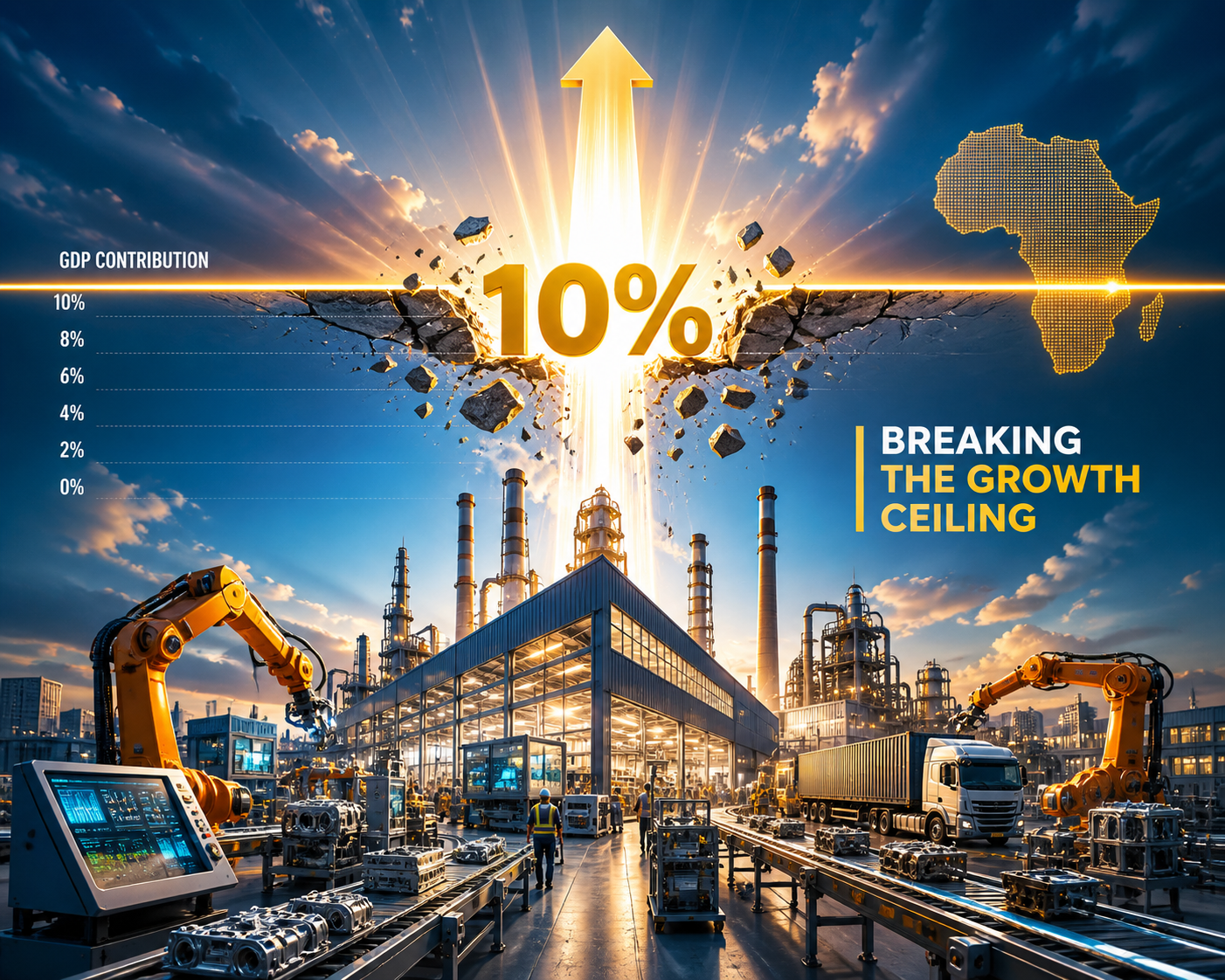
Moving manufacturing to 10% of GDP is not just a statistical target, it represents a structural shift toward industrial depth, value addition, and economic diversification.
Why Manufacturing Matters for Structural Transformation
Manufacturing is widely recognized as a key driver of economic transformation. Unlike extractive industries or low-value services, manufacturing creates strong multiplier effects across the economy.
It drives:
- Employment generation across skill levels
- Expansion of domestic supply chains
- Export diversification beyond raw materials
- Technology transfer and industrial learning
- Productivity improvements across sectors
When manufacturing expands, economies typically become more resilient and less dependent on commodity cycles.
The Current Challenge: Structural Industrial Stagnation
Despite decades of policy focus, many African economies have struggled to expand manufacturing beyond a narrow base.
Several structural constraints explain this stagnation:
High production costs driven by infrastructure gaps, particularly in energy and transport.
Limited access to long-term industrial financing for capital-intensive projects.
Weak integration into global and regional value chains.
Dependence on imported intermediate goods and machinery.
Skills gaps in technical and industrial labour markets.
These constraints reinforce each other, creating a cycle where manufacturing struggles to scale beyond early-stage production.
The 10% GDP Manufacturing Target: What It Represents
A manufacturing share of 10% of GDP is often viewed as a minimum threshold for meaningful industrialization in developing economies.
Reaching this level implies:
- A diversified industrial base beyond basic processing
- Strong domestic value addition systems
- Functional export-oriented manufacturing sectors
- Improved productivity across industrial clusters
It is less about a precise number and more about achieving a tipping point where manufacturing becomes a central pillar of economic growth.
Building the Industrial Framework: Key Pillars of Transformation
To reach a 10% manufacturing share of GDP, African economies must adopt a coordinated industrial strategy built on several core pillars.
1. Infrastructure-Led Industrialization
Manufacturing cannot expand without reliable infrastructure. Energy supply, transport networks, and industrial zones form the foundation of competitiveness.
Industrial parks, logistics corridors, and stable electricity supply systems are essential for reducing production costs and improving scale efficiency.
2. Access to Long-Term Industrial Finance
Manufacturing is capital-intensive and requires long-term financing structures that match production cycles.
This includes:
- Development finance institutions
- Industrial development banks
- Blended finance mechanisms
- Export credit facilities
Without appropriate financing, even viable industrial projects fail to scale.
3. Value Chain Integration and Regional Markets
No single African country has a large enough domestic market to sustain full industrial diversification.
Regional integration is therefore essential.
Frameworks like the AfCFTA enable manufacturers to access larger markets, source inputs more efficiently, and achieve economies of scale.
African Continental Free Trade Area
4. Skills Development and Industrial Labour Capacity
Industrialization requires a workforce capable of operating complex machinery, managing production systems, and maintaining quality standards.
This includes investment in:
- Technical and vocational education
- Engineering and manufacturing disciplines
- Industrial apprenticeship programmes
- Technology transfer partnerships
Without skills development, industrial capacity remains limited regardless of capital investment.
5. Policy Stability and Industrial Incentives
Manufacturing investments are long-term decisions. Policy uncertainty discourages capital allocation into industrial sectors.
Effective industrial policy requires:
- Stable tax and regulatory frameworks
- Predictable incentive systems
- Clear import substitution and export promotion strategies
- Consistent enforcement of industrial standards
Policy credibility is often as important as financial incentives.
The Role of Industrial Clusters
One of the most effective ways to accelerate manufacturing growth is through industrial clustering.
Clusters allow firms to co-locate within designated zones, reducing logistics costs and improving supply chain efficiency.
They also enable:
- Shared infrastructure use
- Supplier ecosystem development
- Faster technology diffusion
- Improved export coordination
Industrial clusters create ecosystems rather than isolated firms, which is critical for scaling manufacturing output.
Export-Led Manufacturing as a Growth Driver
Domestic demand alone is often insufficient to sustain large-scale manufacturing expansion.
Export-oriented strategies allow countries to:
- Access larger demand bases
- Improve production efficiency
- Attract foreign direct investment
- Integrate into global value chains
However, successful export manufacturing requires consistent quality standards and competitive logistics systems.
Technology and Automation in Modern Manufacturing
Modern industrial growth is increasingly shaped by technology adoption.
Automation, digital manufacturing systems, and smart production technologies are reducing reliance on manual labour while increasing output efficiency.
For Africa, this presents both a challenge and an opportunity: leapfrogging traditional industrial stages through selective technology adoption.
Risks to Industrial Expansion
Despite clear potential, several risks continue to slow manufacturing growth:
Infrastructure deficits, particularly unreliable energy supply.
Macroeconomic volatility affecting input costs and exchange rates.
Limited access to industrial raw materials and intermediate goods.
Fragmented regional trade implementation.
These risks require coordinated policy and private sector alignment to overcome.
Conclusion: Manufacturing as a Structural Priority, Not a Sector
Reaching a manufacturing contribution of 10% of GDP is not simply an industrial target, it is a structural transformation objective.
It requires coordinated investment across infrastructure, finance, skills, policy, and regional integration.
Without this alignment, manufacturing will remain constrained. With it, Africa can shift from commodity dependence to industrial competitiveness.
The question is no longer whether industrialisation is possible, but whether it is being structured effectively enough to scale.
Call to Action
For policymakers and private sector leaders, the focus must shift from isolated industrial projects to system-wide manufacturing ecosystems.
Those who invest early in industrial capacity, regional value chains, and production infrastructure will be best positioned to lead Africa’s next phase of economic transformation.