
Introduction
Walk into almost any growing business today and you will find a CRM system. Salesforce, HubSpot, Zoho, Pipedrive, the logos change but the promise remains the same: better sales performance, predictable revenue, deeper customer insights. Executives buy these platforms believing they are purchasing a growth strategy. They are not. They are purchasing a tool.
This is more than a semantic difference. Confusing the tool with the strategy is precisely why so many CRM implementations fail to deliver meaningful return on investment. Research from Gartner has repeatedly shown that a significant percentage of CRM projects do not meet expectations, and a common root cause is the lack of a well-defined sales process and user adoption plan before the technology is deployed. The software gets blamed, but the software was never the problem.
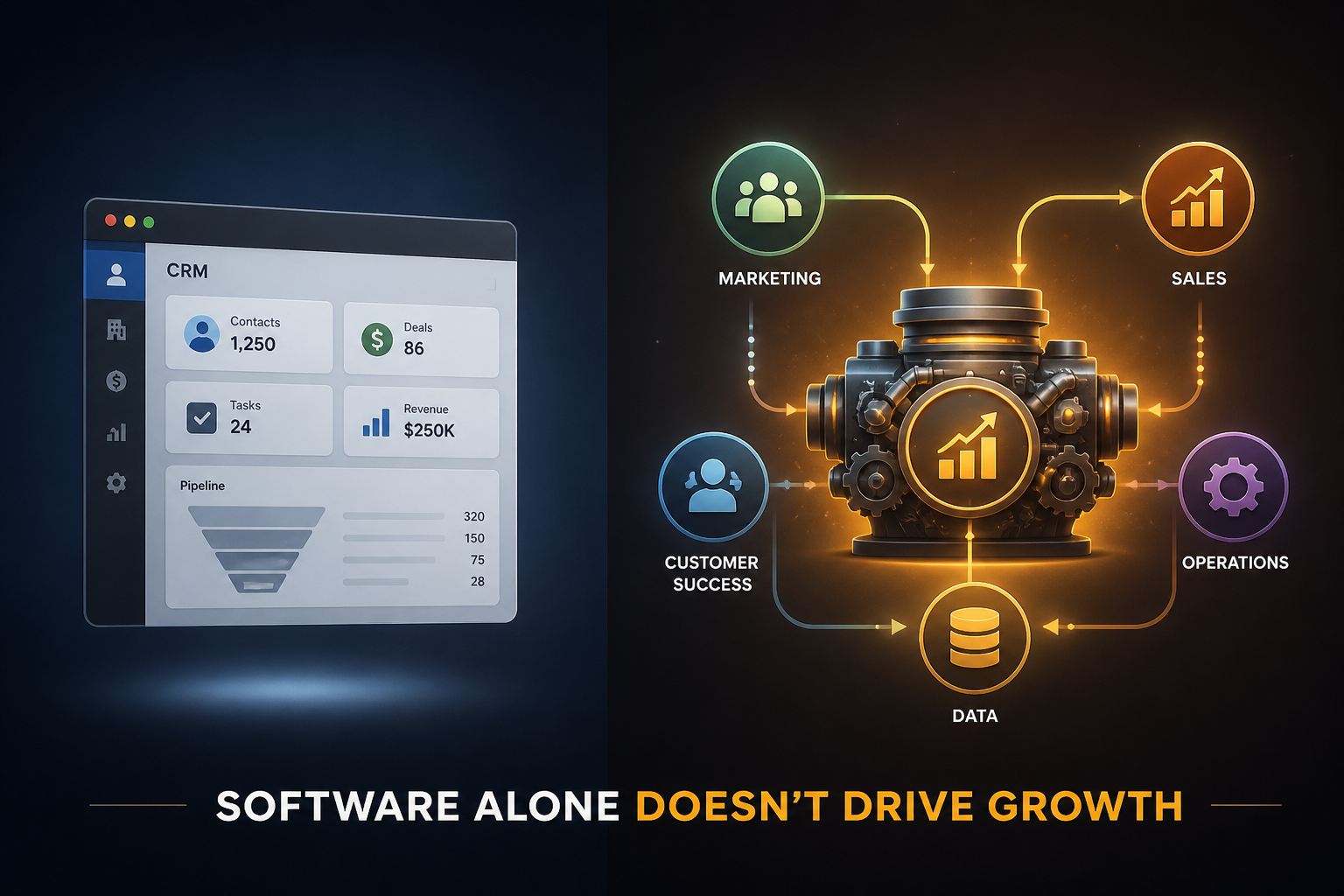
A CRM is a database with workflow capabilities. Whether it becomes a revenue engine or an expensive digital filing cabinet depends entirely on what you build around it. Your sales strategy, your processes, your team’s skills, your coaching cadence, and your leadership expectations form the real engine. The CRM is the dashboard and the fuel injection system, critical, but useless without the engine block.
This guide will take you far beyond the software selection checklist and into the architecture of a genuine revenue engine. You will learn how to design the human and process elements that transform a CRM from a reporting burden into the most powerful growth lever your business possesses.
The CRM Trap: Why Software Alone Fails
The trap is seductive because it often works for a few months. You buy the system, import contacts, maybe run a training session. The sales team logs call and opportunities. A pipeline report emerges that looks clearer than the old spreadsheets. For a quarter, it feels like progress.
Then the cracks appear. Data quality decays as reps get busy. The stages in the pipeline do not match how your customers actually buy, so metrics become misleading. Managers stop trusting the forecast. Reps see the CRM as a surveillance tool for leadership, not something that helps them sell. Meetings shift from coaching to data entry compliance. The tool that was supposed to accelerate growth becomes weight that slows everything down.
This failure pattern has nothing to do with the software code. It has everything to do with the absence of three foundational layers typically missing when businesses buy a CRM:
- A defined sales process that mirrors the actual customer journey, not a generic corporate checklist.
- A behavioural adoption framework that makes CRM usage feel personally valuable to the rep, not just a reporting obligation for management.
- A revenue operations mindset that treats the CRM as the hub of integrated data from marketing, sales, and service, rather than an isolated sales log.
When a leader says “our CRM isn’t working,” what they usually mean is “we deployed software without building the human and process systems that make it work.” The difference between companies that get exponential value from their CRM and those that don’t is not the software brand. It is the level of strategic discipline they wrap around it.
Process Before Platform: Defining Your Revenue Architecture
Before you configure a single field in your CRM, you must define your revenue architecture. This is the clear, documented blueprint of how your business identifies, engages, closes, and expands customer relationships. The CRM is simply the digital incarnation of this blueprint.
A well-designed revenue architecture answers fundamental questions with specificity:
- What exactly defines a qualified lead versus a marketing lead?
- What are the buyer stages that reflect how your actual customers make decisions?
- Which sales activities demonstrably move a deal forward, and which are busywork?
- How do marketing, sales, and customer success hand off responsibility without dropping information or relationship warmth?
The most effective way to build this blueprint is to gather your top-performing salespeople and map their mental models. Do not start with the CRM’s default stages. Instead, listen to how a deal actually progresses. A common B2B journey might look like this: initial interest, problem definition, solution education, vendor comparison, internal approval, negotiation, close, and onboarding. Your CRM stages should mirror this natural progression.
Once the stages are defined, you must attach entry and exit criteria to each one. A deal should not move from “problem definition” to “solution education” unless the buyer has explicitly acknowledged a need and a timeline. Without these guardrails, your pipeline becomes inflated with hope, and your CRM loses forecasting credibility. This process definition creates a shared language. When a rep says a deal is “in negotiation,” everyone now knows exactly what has already occurred and what remains.
If you need help building this from scratch, our guide on designing consistent sales processes for scaling teams walks through the mapping exercise step by step.
Building the Real Revenue Engine: Five Core Components
With your process defined, you can now construct the revenue engine around the CRM. The engine has five interacting components, and skipping any one of them will result in an underpowered system no matter how sophisticated your software.
Component 1: Standardized Workflow, Not Rigidity
A great revenue engine standardizes what should be consistent and leaves room for human creativity where it matters. Standardization means that every rep follows the same defined stages, capturing the same essential data points at each stage. This makes coaching scalable and forecasting possible. But within each stage, the best reps should be free to adapt their messaging, their medium, and their timing to the specific customer.
Imagine a restaurant kitchen. The recipes, ingredient portions, and plating guidelines are standardized so that every dish meets quality expectations and the business can manage costs. But the head chef still tastes, adjusts seasoning, and responds to the evening’s specific demands. Your CRM processes should function the same way, standardized enough for consistency and measurement, flexible enough for human skill to shine.
To achieve this, document the non-negotiable data fields for each pipeline stage. For example:
- When moving to “solution education,” a rep must log the specific business challenge the prospect agreed to and the name of the internal champion.
- When moving to “negotiation,” budget confirmation and a documented timeline are mandatory.
These rules, enforced by the CRM logic itself, create clean data without a manager policing spreadsheets.
Component 2: Rep-Centric Adoption and Value
Adoption cannot be mandated; it must be earned by demonstrating value to the person doing the data entry. The moment a CRM feels like a corporate surveillance tool, reps will game the system, enter minimal data, and mentally check out. Your strategy must flip this perception entirely.
A rep will embrace a CRM that provides clear personal benefits, including:
- Automatic reminders for follow-ups, so nothing slips through the cracks.
- Suggested next-best actions based on historical deal patterns.
- Immediate visibility into which deals are stuck and why.
- Reduced administrative burden by eliminating manual internal reports.
Your CRM dashboards must be configured for the rep first, not just the executive. A rep’s home screen should show their priorities for the day, overdue tasks, and deals that have been idle beyond a threshold. It should feel like a personal assistant, not a manager’s spyglass.
Second, tie CRM usage directly to rep success. When pipeline reviews and coaching sessions are built exclusively from CRM data, and when that data is accurate, reps see that good hygiene leads to better support, faster deal unblocking, and ultimately higher commission checks. This creates a virtuous loop. The moment a rep realizes that a clean pipeline entry helped the manager quickly get an extra discount approved, they become a CRM advocate. External training on effective CRM day-to-day use, such as resources from HubSpot Academy, can also shift the mindset from data entry to productivity.
Component 3: Integrated Data Flows
A CRM locked in a silo is a shadow of its potential. The real revenue engine connects your CRM to the other critical systems that influence revenue outcomes, your marketing automation, your customer support platform, your ERP or billing system, and your communication tools.
Integration accomplishes three things:
- It eliminates duplicate data entry. A lead captured in a marketing campaign flows automatically into the CRM with full context about what they clicked and downloaded, so reps never re-type information.
- It provides a complete customer view. A rep on a call with an existing client can see current support tickets, recent invoices, and product usage data without leaving the CRM screen, transforming conversations from transactional to consultative.
- It enables accurate end-to-end attribution. You can finally connect marketing cost to sales pipeline to closed revenue to churn, giving leadership a unified picture of the revenue machine.
Start with the most painful data gap in your business. If marketing and sales don’t share a common lead definition, fix that integration first. If service handoffs are chaotic, connect the CRM and support platform. Our resource on building a unified tech stack for revenue growth details the integration sequence that works for most scaling companies.
Component 4: Data-Driven Coaching Cadence
The CRM becomes the source of truth for coaching. This does not mean managers stare at a dashboard and send emails demanding activity. It means that every structured coaching conversation begins with the CRM’s objective data about a rep’s pipeline and activities, not with feelings or anecdotes.
A powerful revenue engine embeds a weekly routine. The manager and rep review the pipeline together, deal by deal, using the CRM’s view. The conversation focuses on:
- The quality of opportunities, not just quantity.
- The strength of next steps and action plans.
- Deals that are stalling and the specific blockers in each.
Because the data is current and clean, the rep cannot describe ghost deals, and the manager cannot rely on vague impressions. The discussion is grounded in reality.
Over time, this cadence reveals patterns. You might discover that deals stall most frequently when there is only one contact involved, or that a particular competitor appears at a specific pipeline stage. These insights feed back into your strategy, and you update the CRM’s fields and processes to capture the relevant intelligence earlier. This is the engine learning from itself. Gartner research on sales management underscores that the quality of pipeline reviews is a top predictor of quota attainment, and quality reviews are impossible without trustworthy CRM data.
Component 5: Defined Performance Metrics Beyond Activity
What gets measured gets managed, and traditional CRM metrics like calls made or emails sent measure input, not effectiveness. A modern revenue engine tracks a richer set of indicators, each tied to strategy:
- Conversion rates from stage to stage, not just total pipeline value.
- Velocity—the average time a deal spends in each stage.
- Win rates segmented by lead source, rep, and deal size.
- Customer acquisition cost and lifetime value.
- The percentage of revenue from existing versus new customers.
The CRM becomes a strategic cockpit.
Crucially, these metrics are visible not only to leadership but to the team. When reps see their own conversion rates and velocity metrics, they can self-diagnose. A rep who notices that their deals stall in the education stage can seek specific skill development without being told. This shifts the culture from “management by inspection” to “management by insight,” and it is only possible when the four previous components are solidly in place.
The Human Element: Leadership, Culture, and Change Management
All the processes and technology in the world will fail if leadership does not model and reinforce the right behaviours. The shift from “CRM as a tool” to “CRM as the heart of our revenue engine” is a cultural transformation, and culture follows leadership action, not leadership pronouncement.
First, the senior leadership team must use the CRM’s data for every meeting about revenue. If the executive team makes a major decision based on a separate spreadsheet, the revenue engine is instantly devalued. The rule must be ironclad: if it’s not in the CRM, it doesn’t exist for decision-making purposes. This forces data integrity and signals that this matter.
Second, hold people accountable for process adherence, not just outcomes. If a rep closes a massive deal but completely bypassed the defined sales stages and left no internal trail, celebrate the revenue but coach the process gap. One such deal is an anomaly; repeated, it becomes a culture where the process is optional. Sustainable revenue engines do not run on undisciplined heroics.
Third, invest in ongoing capability, not one-time training. CRM skills and sales process skills degrade without reinforcement. Build a small library of short, specific “how-to” assets:
- Video walkthroughs for critical CRM actions.
- Job aids that summarize the defined entry criteria for each stage.
- A quick reference guide for the decision-level framework.
When a new rep joins, they onboard into a living system, not a forgotten binder.
Measuring the Success of Your Revenue Engine
Deploying a revenue engine is a business investment, and you must define success beyond “we launched the CRM.” The lagging indicator is of course revenue growth, but you need leading indicators that show the engine is gaining power before the top-line number moves.
Leading indicators to track include:
- CRM user adoption rates above 80% for the defined critical actions.
- Pipeline data accuracy within a 10% variance from reality.
- Reduction in the average sales cycle length.
- Improvement in stage-to-stage conversion rates.
- A measurable increase in forecast accuracy.
If the CEO can look at a CRM-generated forecast and have confidence in it six months after implementation, you have built something real.
It is also worth measuring the qualitative shift. Are your pipeline review meetings shorter and sharper? Do reps come with insights from their data rather than excuses? Has the “us versus management” dynamic around CRM softened? These human signals are as important as the numbers, and they reflect genuine transformation.
Conclusion: Your CRM Is Not Your Strategy, You Are
The most sophisticated CRM platform in the world delivers zero strategy on its own. It is an elegant mirror. If you point it at a disciplined, process-driven, human-centered sales organization, it will reflect back clarity, insight, and scalable growth. If you point it at chaos, it will faithfully reflect chaos.
A real revenue engine is the combination of clear process design, rep-centric adoption, integrated data, consistent coaching, and meaningful metrics, all wrapped in the leadership commitment to make the system matter. The CRM is an essential component, but only a component. The engine itself is the strategic capability your business builds, and that capability will long outlast any individual software subscription.
Start today not by opening a CRM demo, but by mapping your actual customer journey with your best salesperson. Document your real stages, your real handoffs, and the information you wish you had at every decision point. That is your strategy. Then, and only then, configure your CRM to support it. You will have stopped buying software and started building an engine.
Call to Action:
Take one immediate step. Choose your most critical sales process, lead to close or renewal, and map it with the team that executes it. Identify where you lack shared definitions. Then explore how your current CRM’s configuration reflects or fights that real-world flow. For additional frameworks on sales process design and technology integration, visit our sales strategy resource hub and revenue operations toolkit.