
Introduction
Across Africa, we celebrate exceptional leaders. The founder who built a bank from nothing. The CEO who turned around a national airline. The executive director who grew a non-profit across ten countries.
These stories are inspiring. They are also incomplete.
Because for every organization that thrived under a great leader, there are ten that collapsed when that leader left. The charismatic founder retires, and the company fractures. The visionary director gets ill, and the team loses direction. The strongman CEO is replaced, and the next person cannot make a single decision without calling the predecessor.
The problem is not leadership. The problem is leadership reliance.
Too many African organizations, from family businesses to government agencies to NGOs, depend on the personality of one individual rather than the durability of a leadership system. When that individual leaves, the organization does not transition. It falls apart.
This article argues that sustainable success across the continent requires a shift: from celebrating leadership personality to building leadership systems.
What Is a Leadership System – and How Is It Different from Leadership Personality?
Leadership personality is about the individual: their charisma, instincts, relationships, and personal authority. It works brilliantly while they are present. It fails when they are not.
Leadership system is about the structure: clear decision‑making frameworks, delegated authority, talent pipelines, feedback loops, and succession protocols. It works regardless of which competent person sits in the chair.
Key differences:
- Decision‑making: A personality‑driven organization requires the leader to approve everything. A system‑driven organization has rules about who decides what, at what threshold.
- Information flow: In a personality‑driven organization, information flows to the leader, who then directs action. In a system‑driven organization, information flows through defined channels, with authority distributed.
- Succession: Personality‑driven organizations panic when the leader leaves. System‑driven organizations have a bench of ready successors and a written transition plan.
- Culture: Personality‑driven culture is “what the boss wants.” System‑driven culture is “how we do things here”, consistent across teams and tenures.
Why Africa Has a Personality Problem
Several factors across the continent reinforce leadership personality over leadership systems.
Factor 1 – Founder‑hero narratives
- Many African businesses were built against enormous odds: no capital, hostile regulation, broken infrastructure.
- The founder is rightfully celebrated as a hero.
- But hero worship makes it hard to question the founder, or to imagine the organization without them.
Factor 2 – Scarcity of professional management
- Truly independent, experienced CEOs and senior managers are still rare in many markets.
- Founders fear that outsiders will not understand local context, so they centralize power in themselves.
Factor 3 – Political leadership models spill over
- In many African countries, national politics rewards strongman personalities and centralized power.
- Business leaders unconsciously copy that model, even though a company is not a presidency.
Factor 4 – Weak institutional history
- Many organizations are only one or two generations old.
- They have never experienced a leadership transition that was planned, orderly, and successful.
- The unknown is terrifying, so leaders cling to the known (themselves).
Factor 5 – Trust deficits
- In low‑trust environments, leaders rely on personal relationships rather than impersonal systems.
- The leader becomes the only person who can negotiate with suppliers, regulators, or key customers, because no one else has the relationships.
The Costs of Personality‑Dependent Leadership
Relying on a single leader is not just risky. It is expensive.
Visible costs:
- Decision bottlenecks: Every choice waits for the leader. Projects stall. Opportunities are missed.
- Burnout: The leader works 80‑hour weeks because no one else has authority. Health suffers. Families suffer.
- Key‑person risk: If the leader is hit by a car, has a stroke, or is poached by a competitor – the organization has no answer.
Hidden costs:
- Stunted talent: Ambitious mid‑level managers leave because they see no path to real responsibility. The organization is left with yes‑people.
- Poor adaptation: The leader’s mental model becomes outdated, but no one challenges it. The organization misses market shifts.
- Lower valuation: Any savvy investor or acquirer discounts a personality‑driven firm heavily. Without the founder, what is it worth? Much less.
How to Build Leadership Systems, Practical Steps
Shifting from personality to systems is not easy. It requires the leader to voluntarily give up power, which goes against every instinct that built the organization. But it can be done.
1. Define Decision Rights Clearly
- Action: Create a simple delegation matrix. For each type of decision (hiring, spending, pricing, strategy), specify who decides at what level.
- Example: “The CFO can approve expenses up to K50,000. Above that, joint signature with the CEO. Above K200,000, board approval required.”
- Result: The CEO stops being the bottleneck for routine decisions.
2. Build a Succession Bench
- Action: Identify at least two internal candidates for every critical leadership role.
- Action: Give them real projects with real authority – not just “shadowing.”
- Action: Write a one‑page succession plan for sudden departure. Update it every six months.
3. Document Critical Relationships
- Action: The leader should not be the only person who knows the supplier’s procurement manager or the regulator’s chief inspector.
- Action: Systematically transfer key relationships. Take the supplier contact to lunch with the procurement lead. Copy the successor on regulatory emails.
- Result: When the leader leaves, relationships do not leave with them.
4. Create a Leadership Cadence, Not a Leadership Crisis
- Action: Schedule regular leadership team meetings where decisions are made collectively, not just announced.
- Action: Rotate meeting facilitation among team members – so everyone practices leading.
- Action: After every major decision, document the rationale. So future leaders understand why, not just what.
5. Install a Board That Holds the System Accountable
- Action: Recruit independent directors who have no personal loyalty to the founder, only loyalty to the organization’s long‑term health.
- Action: Empower the board to review succession planning annually and demand updates.
- Action: Give the board authority to remove the founder from day‑to‑day management if the founder becomes a bottleneck.
6. Measure Leadership Health, Not Just Financial Health
- Action: Add two non‑financial metrics to your quarterly dashboard:
- Bench strength: Number of roles with at least one ready‑now successor.
- Decision speed: Average time from request to decision for routine approvals.
- Action: Review these metrics publicly in leadership meetings. Celebrate improvements.
The Role of the Leader: From Hero to Architect
The hardest part of building leadership systems is that the leader must lead the change, and then gradually step back.
The shift in identity required:
- From: “I am the one who solves every problem.”
- To: “I am the one who builds the system that solves problems, even when I am not here.”
What the leader gains by letting go:
- More time for strategy, not firefighting.
- A more capable, confident team.
- An organization that can survive them.
- A legacy that is not a memory, but an engine.
What the leader risks by holding on:
- Burnout, as described.
- Collapse upon departure.
- A life’s work that lasts only as long as they do.
Conclusion: Systems Outlast Personalities
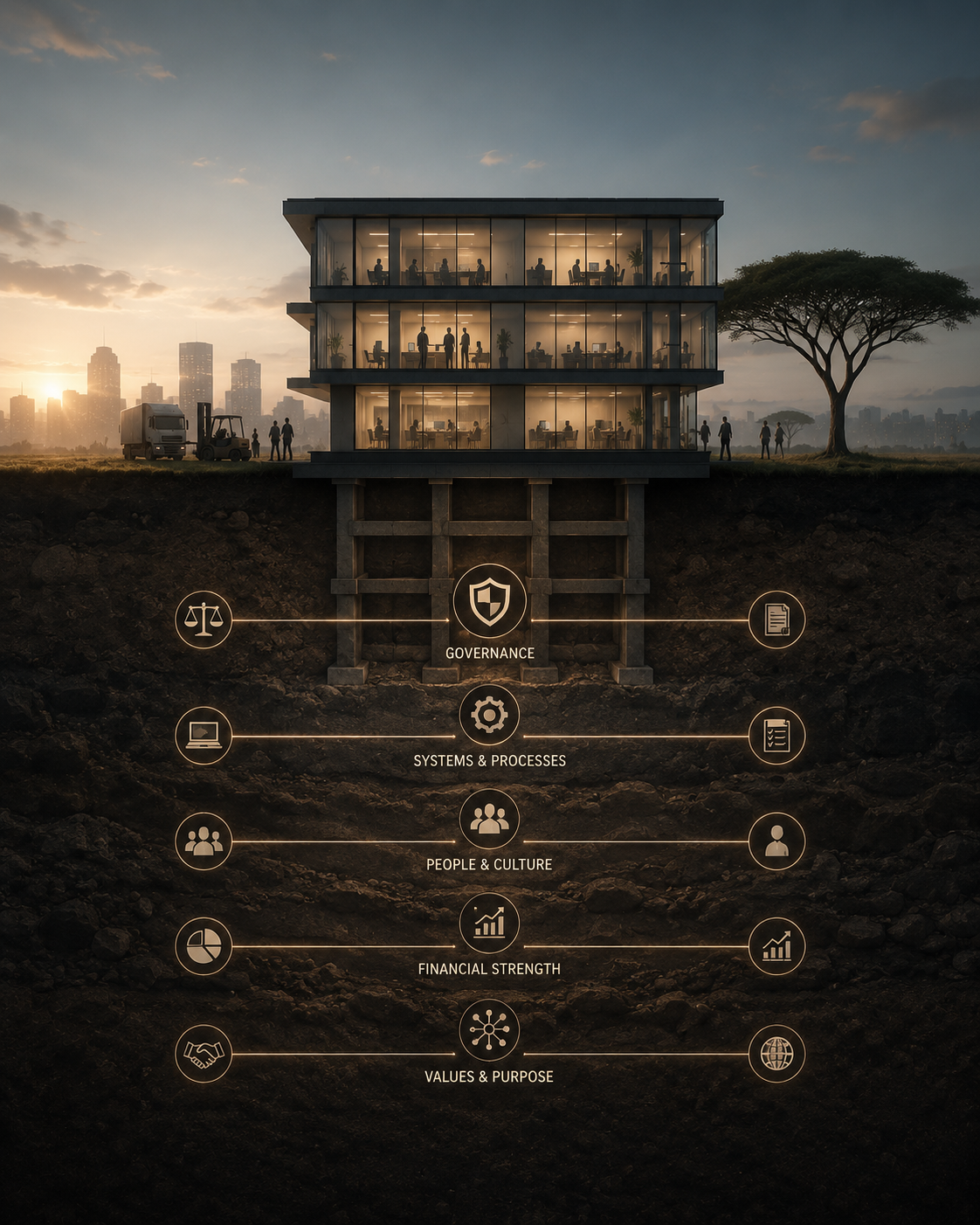
Africa has had more than enough charismatic leaders. What it needs now are leadership architects, men and women who build systems that outlast them.
- A personality‑driven organization is a monument to one person. It crumbles when they fall.
- A system‑driven organization is a machine that runs on talent, not magic. It adapts. It endures.
The choice is not between strong leadership and no leadership. The choice is between leadership that is fragile, and leadership that is resilient.
Build the systems. Train the successors. Document the wisdom. Then step back and watch what you built grow beyond you.
Call to Action
This week, identify one decision that you, the leader, make repeatedly that someone else could make.
- Write down the criteria for that decision.
- Delegate it to a trusted team member with clear boundaries.
- Check in after one month. Did the world end? Probably not.
Then find a second decision. And a third. Each delegation is a brick in your leadership system.
One day, you will leave. What you build now determines whether your organization continues, or ends.